
MCAT CARS (MCAT Critical Analysis
and Reasoning Skills)
Expert MCAT CARS Strategies and 5 High-Yield
Practice Tests

The Critical Analysis and Reasoning Skills (CARS) section of the MCAT is often cited by pre-med students as the most difficult part of the MCAT to improve. Unlike the science sections, you cannot rely on memorization. Success requires a shift in how you process information, analyze arguments, and manage your time.
At Gold Standard MCAT, we provide the structured practice and the specific "logical lens" required to achieve a 130+ score.
What is MCAT CARS?
The MCAT CARS section consists of nine passages, each 500 to 600 words long, followed by a series of questions. You have 90 minutes to complete a total of 53 questions.
- You are not expected to have prior knowledge of the topics. Everything you need to answer the questions is within the text.
- The AAMC uses CARS to assess your ability to comprehend, analyze, and apply information—skills that are vital for success in medical school and clinical practice.
Techniques and strategies for MCAT CARS
To conquer CARS, you need more than just reading speed; you need a system. Here are the core strategies taught in the Gold Standard curriculum:
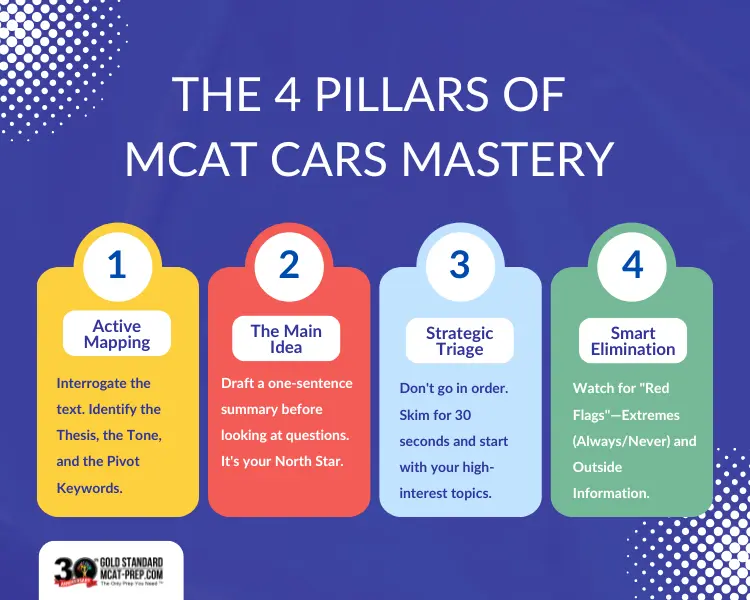
1. Active Reading & Mapping
Don't just read the words; engage with the author's argument. As you read, mentally (or physically) "map" the passage by identifying:
- The Thesis: What is the author's primary goal?
- Tone: Is the author skeptical, enthusiastic, or objective?
- Keywords: Watch for "pivot words" like however, despite, furthermore, or consequently that signal a change in direction.
2. The "Main Idea" Rule
Before looking at the questions, summarize the main idea in one sentence. If an answer choice contradicts the main idea, it is almost certainly wrong.
3. Triage the Passages
You don't have to do the passages in order. Spend 30 seconds skimming the first paragraph of each. Start with topics that interest you (e.g., history or philosophy) to build momentum and save the most difficult or dense passages for last.
4. Use the Process of Elimination (POE)
CARS questions often have "distractor" answers. Beware of choices that are:
- Too Broad/Narrow: They don't cover the scope of the question.
- Beyond the Text: They introduce information not found in the passage.
- Extreme Language: Phrases like "always," "never," or "must" are rarely correct in a nuanced argument.
Put your MCAT CARS strategy to the test
Free MCAT CARS Diagnostic
Want to test your CARS skills for free? Get access to our free MCAT Practice Test. You can choose to take just the 90-minute CARS section to get your baseline score, or complete all 4 sections for a total diagnostic.
Gold Standard MCAT CARS Booster + 5 Tests
For students serious about hitting a 130+, one test isn't enough. Build stamina and master every passage type with our comprehensive CARS bundle.
5 Full-Length Tests: Includes 5 dedicated CARS exams (45 total passages, 265 questions). Tests are different from those included in our 7 Gold Standard full-length MCAT practice tests.
AAMC Format: Each test features the standard 9 passages and 53 questions in a 90-minute timed environment.
Flexible Timing Options:
Standard Timer: 90 minutes to simulate test day.
Remove Timer: For students focusing on accuracy before speed.
Time Extension: Designed for students with testing accommodations.
Detailed Explanations: We don’t just tell you which answer is right; we explain why the others are wrong, identifying the specific reasoning skill and content category for every question.
Score Analytics: All attempts are saved in your Personal History, showing your raw scores and estimated scaled scores to track your progress.
Warm-up Exercises and Strategies: Includes specific drills to help you transition into the "CARS mindset" before you start a full test.
Access: 3 Months of unlimited attempts.
Pricing: $69 $99
MCAT CARS Passage Content Categories
The CARS section pulls from two main areas. Knowing the "flavor" of these passages helps you adjust your reading mindset.
| Category | Distribution | Examples |
|---|---|---|
| Humanities | 50% | Architecture, Art, Dance, Ethics, Literature, Music, Philosophy, Popular Culture, Religion, Theater, and Studies of Diverse Cultures*. |
| Social Sciences | 50% | Anthropology, Archaeology, Economics, Education, Geography, History, Linguistics, Political Science, Population Health, Psychology, Sociology and Studies of Diverse Cultures*. |
Question Types: What They Are and How They Are Distributed
The AAMC categorizes CARS questions into three distinct cognitive levels. Understanding these allows you to approach each question with the right "lens."
1. Foundations of Comprehension (30%) These questions test your basic understanding of the passage. They may ask for the main point or to define a term based on context.
2. Reasoning Within the Text (30%) These require you to identify how different parts of the passage relate to one another. You might be asked how one paragraph supports or contradicts another.
3. Reasoning Beyond the Text (40%) The most difficult type. These ask you to apply the author's logic to a brand-new scenario or to determine how new information would affect the author's original argument.
Comprehensive Prep: Included in Our Full Packages
| Feature | Standalone MCAT CARS Tests | MCAT Crash Course | Home Study MCAT Prep Package |
|---|---|---|---|
| 5 CARS Practice Tests and Strategies | ✓ | ✓ | ✓ |
| Detailed Explanations | ✓ | ✓ | ✓ |
| Science Review e-Books | ✗ | ✓ | ✓ |
| Full-Length MCAT Exams | ✗ | 2 | 12 |
| Price | $69 (3 months) | View Details | View Details |
MCAT CARS Sample Passage and Questions by Gold Standard
Challenge yourself with this representative passage and see how you rank. In the actual MCAT, each CARS passage is followed by 5 to 6 questions to test the full range of your reasoning skills. While we have provided two sample questions here for each passage to illustrate the logic required, our full practice tests mirror the real exam's interface and question volume exactly.
The Historical Narrative (Humanities)
The history of the Victorian Age will never be written; we know too much about it. For ignorance is the first requisite of the historian—ignorance, which simplifies and clarifies, which selects and omits, with a placid perfection unattainable by the highest art. Concerning the Age which has just passed, our fathers and our grandfathers have poured forth and accumulated so vast a quantity of information that the industry of a Ranke would be submerged by it, and the perspicacity of a Gibbon would quail before it.
It is not by the direct method of a scrupulous narration that the explorer of the past can hope to depict that singular epoch. If he is wise, he will adopt a subtler strategy. He will attack his subject in unexpected places; he will fall upon the flank, or the rear; he will shoot a sudden, revealing searchlight into obscure recesses, hitherto undivined. He will row out over that great ocean of material, and lower down into it, here and there, a little bucket, which will bring up to the light of day some characteristic specimen, from those far depths, to be examined with a careful curiosity.
Guided by these considerations, I have written the ensuing studies. I have attempted, through the medium of biography, to present some Victorian visions to the modern eye. They are, in one sense, haphazard visions—that is to say, my choice of subjects has been determined not by the desire to construct a system or to prove a theory, but by simple motives of convenience and of art. It has been my purpose to illustrate rather than to explain. It would have been futile to hope to tell even a precis of the truth about the Victorian age, for the shortest precis must fill innumerable volumes. But, in the lives of an ecclesiastic, an educational authority, a woman of action, and a man of adventure, I have sought to examine and elucidate certain fragments of the truth which took my fancy and lay to my hand.
I hope, however, that the following pages may prove to be of interest from the strictly biographical, no less than from the historical point of view. Human beings are too important to be treated as mere symptoms of the past. They have a value which is independent of any temporal processes—which is eternal, and must be felt for its own sake. The art of biography seems to have fallen on evil times in England. We have had, it is true, a few masterpieces, but we have never had, like the French, a great biographical tradition; we have had no Fontenelles and Condorcets, with their incomparable eloges, compressing into a few shining pages the manifold existences of men.
With us, the most delicate and humane of all the branches of the art of writing has been relegated to the journeymen of letters; we do not reflect that it is perhaps as difficult to write a good life as to live one. Those two fat volumes, with which it is our custom to commemorate the dead—who does not know them, with their ill-digested masses of material, their slipshod style, their tone of tedious panegyric, their lamentable lack of selection, of detachment, of design? They are as familiar as the cortege of the undertaker, and wear the same air of slow, funereal barbarism. One is tempted to suppose, of some of them, that they were composed by that functionary as the final item of his job. The studies in this book are indebted, in more ways than one, to such works—works which certainly deserve the name of Standard Biographies.
For they have provided me not only with much indispensable information, but with something even more precious—an example. How many lessons are to be learned from them! But it is hardly necessary to particularise. To preserve, for instance, a becoming brevity—a brevity which excludes everything that is redundant and nothing that is significant—that, surely, is the first duty of the biographer. The second, no less surely, is to maintain his own freedom of spirit. It is not his business to be complimentary; it is his business to lay bare the facts of the case, as he understands them. That is what I have aimed at in this book—to lay bare the facts of some cases, as I understand them, dispassionately, impartially, and without ulterior intentions. To quote the words of a Master—“Je n'impose rien; je ne propose rien: j'expose.” [I impose nothing; I propose nothing; I expose.] Wilson, A. N. (1990). Eminent Victorians. New York: W.W. Norton.
MCAT CARS Sample Question 1
According to the passage information, which trait is necessary for a historical biographer?
MCAT CARS Sample Question 2
Which of the following statements would the author of the passage most probably agree with?
The Social Science Critique (Social Sciences)
Only one rule in medical ethics need concern you – that action on your part which best conserves the interests of your patient. ~Martin H. Fischer
I wondher why ye can always read a doctor's bill an' ye niver can read his purscription. ~Finley Peter Dunne
I recall, many years ago, how I wanted to mail a research questionnaire to the general community, on an issue in mental health. As a faculty member of a large Boston teaching hospital, I was surprised to learn that my “simple little questionnaire” had to undergo extensive evaluation by our institutional review board (IRB). How, I was asked, might this questionnaire affect a recipient's mental health? Would the shock of receiving it in the mail cause some people to become anxious or depressed? How would I protect the confidentiality of those who responded, even though the forms did not require any names? (Perhaps, the IRB opined, some subjects could be identified on the basis of their demographics). I considered our IRB's concerns fussy and obsessive, and to this day, I still do. And yet, examined from within the moral framework constructed by Prof. James M. Dubois in his excellent new Ethics in Mental Health Research, I can understand (sort of) why our IRB raised these issues.
Prof. DuBois, the Chair of the Department of Health Ethics at Saint Louis University, is aware that special issues arise when discussing research on those diagnosed with mental illness. Although the book appears aimed at “mental health researchers, IRB members, and research advocates,” I believe it will be of interest to most physicians and mental health professionals who struggle with issues in medical ethics. As Prof. DuBois shows with admirable clarity, there are rarely simple or easy answers to the conundrums that arise in these fields. He therefore advocates a “balanced approach” to research ethics, realizing that while the rights of mentally ill persons must be protected, “research holds an important key to improving the lives of people who suffer from mental disorders.“
In ten well-written chapters – remarkably, all penned by Prof. DuBois – the entire range of topics in mental health research is covered. The first three chapters develop theoretical foundations for research ethics, including a splendid chapter entitled “An Ethical Framework for Research.” Focusing on the Belmont Report (1976–78), DuBois lays out the three cardinal principles of research ethics: respect for persons, beneficence, and justice. The last principle has to do with “the distribution not only of the benefits of research...but also the burdens of participation in research.” Chapter three provides a useful framework for addressing ethical dilemmas and “balancing competing goods and principles.” The remainder of the book deals with “applied” topics, such as informed consent, decision-making capacity, risk-benefit analysis, participant recruitment, privacy and confidentiality, and conflicts of interest. This last chapter is particularly helpful and practical, even as it reveals an array of ethical minefields awaiting the unwary clinician.
Prof. Dubois carefully avoids either pontificating or providing legal advice. Rather, he approaches the dilemmas of research ethics analytically, with numerous engaging case vignettes followed by DuBois' own commentary. These vignettes and their discussions do not “solve“ the dilemmas posed; rather, they provide an analytical framework within which the researcher may understand and confront these conundrums.
DuBois is acutely aware of how language enters into debates about medical ethics, and spends time discussing the various constituencies and vested interests behind terms like “patient,” “consumer,” “client,” and “mental disorder.” Physicians will be pleased that, in general, they are not relegated to the Orwellian category of “providers” (a term that always conjures up someone in a white coat placing a food pellet into the mouth of a lab animal). Also evident throughout the book is a sense of fair-mindedness and humane values: DuBois is not one to demonize, though Dubois has some harsh words for the mental health field in the introduction of the book. (The allusion to “the lack of successful treatments” in mental health care is both gratuitously insulting and factually inaccurate, notwithstanding the over-selling of some modern-day pharmaco-therapies. Lithium, electroconvulsive therapy, and cognitive-behavioral therapy are all examples of remarkably successful treatments, despite the misapplication of ECT in the early days of its use).
Such quibbles aside, I believe that Prof. DuBois' Ethics in Mental Health Research will set the standard for reasoned discussion of mental health research, and the moral dilemmas that arise therein. Although I would have liked more material specifically relating to psychiatrists and other physicians, I found much food for thought in the case vignettes. I believe that any mental health professional contemplating a research project would be remiss if he or she did not consult this wise and well-reasoned book.
DuBois, J. M. (2008). Ethics in mental health research: Principles, guidance, and cases. New York, NY, US: Oxford University Press.
MCAT CARS Sample Question 3
Based on the passage, we can infer that the book helped explain the IRB's behavior (described in paragraph 1) by showing that:
MCAT CARS Sample Question 4
Which of the following would provide an example of the named principle of “justice”?
The Philosophical Masterclass (Philosophy)
In thinking over a long period about the various ways in which freedom may be conceptualized, I came to see that it is, as I came to put it, a robustly or modally demanding value. Suppose you agree with Isaiah Berlin and the long tradition beginning with Jeremy Bentham that to be free in a choice between certain options, X, Y and Z, is just to escape the interference of others with any of those options. This ideal requires more than escaping interference with the option you happen to prefer: that is, escaping the frustration of your actual preference. It requires escaping interference and frustration with any of the options that define the choice. You must not be interfered with in your actual choice of, say, X. But equally it must be the case that had you preferred Y or Z, you would not have been interfered with in that event either.
Freedom requires actual non-interference but also non-interference in the nearest possible worlds where you choose Y or Z instead. Indeed, plausibly, it requires that for a range of possible worlds where you choose X but in a somewhat different manner from that in which you actually choose it, and for a range of possible worlds in which you choose Y and Z instead, you should escape interference. In a phrase, freedom as Berlin understands it requires robust non-interference: that is, non-interference in a range of relevant possible worlds, including the actual one. It is a robustly or modally demanding value.
The range of worlds where you must escape interference for enjoying freedom in this sense may be capable of being identified only on a context-sensitive basis, with intuition playing an important role in determining the boundaries. But one thing that is quite clear is that they may include worlds that are very improbable. You may be very unlikely to choose Y or Z as distinct from X but if you are to enjoy freedom in the exercise of the X-Y-Z choice then you must escape interference even in the unlikely event of choosing one of those options.
Freedom, as Berlin puts it, requires each option to be an open door. It is not enough for the door you happen to push on to be open. And it is not enough for doors to be likely to be open in proportion to the probability of your choosing them. They must be open, period. The republican conception of freedom as non-domination that I have defended in earlier work strengthens the modal requirements of freedom as non-interference, even when it is agreed that the non-interference should be present in possible as well as actual worlds.
It requires not just that each door should be open in a free choice but that its remaining open should not be dependent on the goodwill of any powerful doorkeeper. Were X,Y and Z to be open doors for you but only so long as I remain favorably disposed, then you would be dependent on the state of my will as to whether you can access X or Y or Z. You would be subject to my will in the exercise of the choice, since my will would be in ultimate control. And by traditional connotations, you would therefore enjoy something less than freedom. You might have latitude or leeway in the choice, given that I remain favorably disposed, but you would have that latitude in the manner of a subject or slave, not in the manner of someone who is his or her own person. You might have free rein, as a horse has free rein when the rider allows it to follow its nose. But I would still be in the saddle, determining the limits within which you can continue to enjoy free rein.
I do not wish to defend either the conception of freedom as non-interference or the stronger conception of freedom as non-domination. I mention them only as examples of modally demanding values. Freedom under either construal is a rich value that has a thinner counterpart, which we may describe as the non-frustration of an option. The rich value requires the thin counterpart to be present, not just in the actual world, but also in a range of possible worlds: in the case of freedom as non-interference in a narrower range, and in the case of freedom as non-domination in a wider range.
Both exemplify a structure that is to be found in other values as well. And that is what currently interests me, since the presence of the structure, as we shall see, has significant normative implications. In order to see that the structure is present elsewhere, think about the value of love or friendship. Think in particular about Oscar Wilde’s play, The Importance of Being Earnest. In this wonderful comedy, the protagonists, Jack and Algernon, each face the problem that their fiancées believe them to be called Ernest and protest moreover that they couldn’t love a man that wasn’t called by that name. Each fiancée finds the name Ernest to be uniquely reassuring... The assumption is clear. Jack and Algernon each feel that love is a rich value that requires the lover to bestow affection on her beloved, not just in the actual world — the world where he is apparently called Ernest — but also in a range of possible worlds, and particularly in worlds where he is called Jack or Algernon.
Pettit, P. (July 2011). The Instability of Freedom as Noninterference: The Case of Isaiah Berlin. Ethics, 121(4), 693-716.
MCAT CARS Sample Question 5
Why does the author introduce the example from The Importance of Being Earnest in paragraph 7?
MCAT CARS Sample Question 6
What else would count as an example of a “rich value” like those the author discusses here?
Frequently Asked Questions About MCAT CARS
How do I improve my MCAT CARS score?
Improvement in CARS comes from shifting your focus from what is being said to how and why it is being said. Success requires consistent practice with high-quality passages, followed by a "blind review" of your mistakes to identify logical gaps in your reasoning.
Why is 3rd-party CARS practice essential?
While official AAMC materials are the "gold standard," they are limited in volume (roughly 300 questions). Most students need significantly more practice to build the reading stamina required for a 90-minute exam. Using Gold Standard’s 5-test pack allows you to:
- Preserve AAMC Material: Save the limited official questions for the final weeks of your prep.
- Build Stamina: Develop the focus needed to read 9 consecutive dense passages without "brain fog."
- Identify Patterns: Exposure to a wider variety of humanities and social science topics ensures you aren't surprised on test day.
Is the CARS section the most important part of the MCAT?
While all sections are important, many medical school admissions committees pay close attention to CARS because it is a strong predictor of success in medical school. It demonstrates your ability to process complex information and think critically under pressure.
How many passages and questions are in MCAT CARS?
The MCAT CARS section consists of 9 passages and 53 multiple-choice questions. You are given 90 minutes to complete the section, which averages out to exactly 10 minutes per passage.
Can I use outside knowledge in the CARS section?
No. Using outside knowledge is one of the most common mistakes students make. Every answer is based strictly on the evidence provided in the passage. If you find yourself thinking, "I know this from my history class," stop and look for evidence in the text instead.
What is a "good" MCAT CARS score?
A score of 127 to 132 is generally considered highly competitive. However, because CARS is notoriously difficult, even a score of 125 or 126 is sufficient for many medical school programs, provided your science scores are strong.
Choose Your Path to MCAT Success
Whether you need a targeted CARS boost or a total MCAT overhaul, we have a solution that fits your schedule and budget.
- MCAT CARS Booster ($69) Perfect for students who are already strong in the sciences but need to bridge the gap in their verbal score. [Buy the CARS + 5 Tests Pack Now]
- MCAT Crash Course Our accelerated program for students on a tight timeline. Includes the MCAT CARS Booster plus a comprehensive science review and 7 full-length exams. [Learn More About the Crash Course]
- Home Study MCAT Prep Package The most comprehensive option available. Includes our full set of prep books, online videos, and every practice test we offer. [Learn More About Home Study]
Editorial Note: This content and the accompanying practice materials were developed and vetted by the Gold Standard MCAT Editorial Team. Our team consists of experienced medical educators, physicians, and CARS specialists dedicated to providing the most accurate and representative prep materials for U.S. and Canadian premedical students.