
MCAT Organic Chemistry Mechanisms Summary
Gold Standard MCAT Organic Chemistry Mechanisms and Reactions ('cheat sheet' notes)
Conquer MCAT Organic Chemistry Reactions with our high-yield Mechanisms Summary! This page highlights the most frequently tested key reaction mechanisms and concepts. By grounding your review in basics like electrostatics (opposites attract), you will successfully minimize memorization and master complex reaction pathways. Ready to test your knowledge? Check out the full topic list or access targeted Organic Chemistry practice questions in our free MCAT practice test today!
Download the Gold Standard Organic General Chemistry Summary PDF for FREE (no registration required).
Carboxylic Acid Synthesis and Nucleophilic Acyl Substitution

Reactions of Aldehydes and Ketones: Nucleophilic Addition
High-Yield MCAT Organic Chemistry Reactions List
Most reactions presented can be derived from basic principles (i.e. ORG 1.6, 7. 1). Many of the reactions are cross-referenced for further information.
- An acid chloride reacts with a Grignard reagent to produce a tertiary alcohol. See ORG 1.6, 9.1.
- An acid chloride reacts with a primary or secondary amine to produce an amide. See ORG 9.3 & 11.2.
- A carboxylic acid reacts with SOCl2 or PCl5 to produce an acid chloride. See ORG 9.1
- An acid chloride reacts with an alcohol (e.g. ethanol) to produce an ester. See ORG 9.4.
- An amide reacts with LiAlH4 to produce an amine. See ORG 8.2, 9.3.
- A carboxylic acid reacts with an alcohol (e.g. ethanol) to produce an ester. See ORG 8.2.
- An ester reacts with LiAlH4 to produce a primary alcohol. See ORG 8.2, 9.4.
- A carboxylic acid reacts with base to produce a carboxylate anion. See CHM 6.3 & ORG 8.1.
- An ester reacts with a Grignard reagent to produce a tertiary alcohol. See ORG 1.6, 8.1.1, 9.4.
- A Grignard reagent reacts with carbon dioxide to produce a carboxylic acid. See ORG 8.1.1.
- A nitrile reacts with aqueous acid to produce a carboxylic acid. See ORG 8.1.1.
- A carboxylate ion reacts with ethyl iodide to produce an ester.
- An alkyl halide reacts with Mg/ether to produce a Grignard reagent.
- An alkyl halide reacts with NaCN to produce a nitrile. See ORG 6.2.3.
- A nitrile reacts with LiAlH4 to produce an amine. See ORG 8.2.
- A primary alcohol reacts with HBr to produce an alkyl halide.
- An acid chloride reacts with NaBH4 to produce a primary alcohol. See ORG 8.2, 9.1.
- A primary alcohol reacts with CrO3/pyridine to produce an aldehyde. See ORG 6.2.2, 7.2.1.
- A acid chloride reacts with H2/Pd/C to produce an aldehyde. See ORG 7.1, 7.2.1, 9.1.
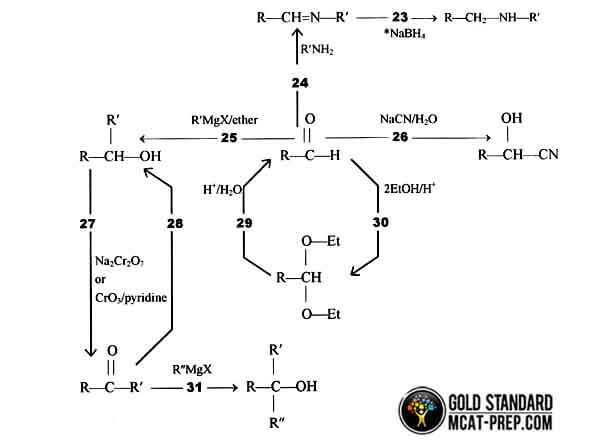
- An aldehyde reacts with NaBH4 to produce a primary or secondary alcohol. See ORG 7.1, 8.2.
- An aldehyde reacts with KMnO4 to produce a carboxylic acid. See ORG 7.2.1, 8.1.1.
- A carboxylic acid reacts with LiAlH4 to produce a primary alcohol. See ORG 8.2.
- An imine reacts with NaBH4 to produce a secondary amine. See 7.2.3, 8.2.
- An aldehyde reacts with a primary amine to produce an imine. See ORG 7.2.3.
- An aldehyde reacts with a Grignard reagent and ether to produce a secondary alcohol. See ORG 1.6, 7.1.
- An aldehyde reacts with aqueous NaCN. See ORG 7.1.
- A secondary alcohol reacts with Na2CrO7 or CrO3/pyridine to produce a ketone. See ORG 6.2.2.
- A ketone reacts with NaBH4 to produce a secondary alcohol. See ORG 7.2.1.
- An acetal reacts with aqueous acid to produce an aldehyde. See ORG 7.2.1/2.
- An aldehyde reacts with an alcohol (e.g. ethanol) and acid to produce an acetal. Note that using with less EtOH/H+, a hemiacetal will form. See ORG 7.2.2.
- A ketone reacts with a Grignard reagent to produce a tertiary alcohol. See ORG 1.6, 9.
IR Spectroscopy
Memorize at least the following IR spectra data for the MCAT:
- Approx. 3300 cm-1 for -OH (alcohol functional group)
- Approx. 1700 cm-1 for C=O (carbonyl functional group)
Editorial Note: This content and the accompanying practice materials were developed and vetted by the Gold Standard MCAT Editorial Team. Our team—consisting of experienced medical educators, physicians, and subject matter specialists—is dedicated to providing the most accurate, representative prep materials and online courses for U.S. and Canadian premedical students.