
MCAT Physics Equations Sheet
Free MCAT Physics Equations Sheet, Formulas, and Study Tips
How to Use This Page | MCAT Essential Equations | Equation Pairs | Atomic Structure | Trigonometry | Units & Constants | MCAT Physics FAQs | Practice Next
Use this MCAT Physics Equations Sheet to review the formulas, equation pairs, units, and constants most likely to matter on test day. This page is designed to help you do more than memorize. You need to know what each equation means, when to use it, and how to apply it quickly in MCAT-style questions.
Download the free PDF, then use the sections below to strengthen your physics recall, problem solving, and test-day confidence.
Technical note: If you do not see Greek symbols such as α, μ, and Δ correctly on your browser, the equations may not display properly. Adjust your browser font settings to Unicode if needed.
Watch a Physics Video from Our MCAT Videos Library
Reviewing equations is a great start, but the MCAT also tests whether you can recognize the right formula, combine concepts quickly, and solve under pressure. Use this sheet with video review and realistic practice to strengthen both recall and application.
How to Use This MCAT Physics Equations Sheet
Do not treat this page like a formula dump to glance at once and forget. Use it as a study tool.
- review the most important equations first
- learn which formulas work together as pairs
- memorize the units and constants that show up repeatedly
- practice applying equations in timed questions
- rehearse your formula recall on a noteboard before full-length exams
If you can recognize the setup of a question and choose the right equation quickly, you will feel much more confident on test day.
Use These Formulas in Real MCAT Questions
Memorizing equations is only the first step. The MCAT tests whether you can identify when a formula applies, estimate quickly, and connect the equation to the science in a passage or discrete question.
After reviewing this sheet, the best next step is to apply what you know in realistic MCAT practice.
MCAT Physics equations to memorize
MCAT Physics throws a lot of equations your way, but don't worry—you don't have to remember them all! This guide focuses on the must-know, essential formulas you'll need to master for the exam, covering core concepts from motion (think: translating objects from point A to B) all the way to refraction and how light bends. By mastering these key equations, you'll have a solid foundation for tackling MCAT physics problems and feeling confident on test day.
Physics equations (formulas) to memorize as pairs
MCAT Physics loves to test your understanding through equations, but memorizing everything can be overwhelming. By mastering these essential equation pairs, you'll unlock a powerful problem-solving approach that will conquer the MCAT physics section.
| F = ma | Similar Form |
| F = qE | |
| F = KG ( m1 m2 / r2 ) | |
| F = k ( q1 q2 / r2 ) | |
| V = IR | Paired Use |
| P = IV | |
| vav = Δ d / Δ t | (avg vel, acc) |
| aav = Δ v / Δ t | |
| v = λ f | (f = 1/T) |
| E = hf | |
| Ek = 1/2 mv2 | (kin, pot E) |
| Ep = mgh | |
| Ρ = F/A | (pressure Ρ) |
| Δ Ρ = ρgΔh | |
| SG = ρ substance / ρ water | (Spec Grav) |
| ρ = 1 g/cm3 = 103 kg/m3 | |
| ρ = mass / volume | (buoyant F) |
| Fb = Vρg = mg | |
| 1/ i + 1/ o = 1/ f = 2/r = Power | Optics |
| M = magnification = - i/o | |
| ΔG = ΔH - TΔS | ΔG° = -RTln Keq |
| Gibbs Free Energy | |
| F = ma | F = qE | Similar Form |
| F = KG ( m1 m2 / r2 ) | F = k ( q1 q2 / r2 ) | |
| V = IR | P = IV | Paired Use |
| vav = Δ d / Δ t | aav = Δ v / Δ t | (avg vel, acc) |
| v = λ f | E = hf | (f = 1/T) |
| Ek = 1/2 mv2 | Ep = mgh | (kin, pot E) |
| Ρ = F/A | Δ Ρ = ρgΔh | (pressure Ρ) |
| SG = ρ substance / ρ water | ρ = 1 g/cm3 = 103 kg/m3 | (Spec Grav) |
| ρ = mass / volume | Fb = Vρg = mg | (buoyant F) |
| 1/ i + 1/ o = 1/ f = 2/r = Power | M = magnification = - i/o | Optics |
| ΔG = ΔH - TΔS | Gibbs Free Energy | ΔG° = -RTln Keq |
Note: Specific gravity (SG) is equivalent to the fraction of the height of a buoyant object below the surface of the fluid.
Atomic nucleus & electronic structure
MCAT Physics loves to test your understanding of the atom's inner workings! This guide will crack open the atomic nucleus and unravel the mysteries of electronic structure.
- Alpha (α) particle = 2He4 (helium nucleus);
- Beta (β) particle = -1e0 (an electron);
- A positron = +1e0 (same mass as an electron but opposite charge);
- Gamma (γ) ray = no mass, no charge, just electromagnetic energy;
- Δ m /Δ t = rate of decay where Δ m = change in mass, Δ t = change in time.
- If the number of half-lifes n are known we can calculate the percentage of a pure radioactive sample left after undergoing decay since the fraction remaining = (1/2)n.
- Nelectrons = 2 n2 , where Nelectrons designates the number of electrons in shell n.
- The state of each electron is determined by the four quantum numbers:
- Principal quantum number = n
- Determines the number of shells
- Possible values are: 1 (K), 2 (L), 3 (M), etc...
- Angular momentum quantum number = l
- Determines the subshell
- Possible values are: 0 (s), 1 (p), 2 (d), 3 (f), n-1, etc...
- Magnetic momentum quantum number = ml
- Determines the orbital
- Possible values are: ± l , ... , 0
- Spin quantum number = ms
- Determines the direction of rotation of the electron
- Possible values are: ± 1/2
- Principal quantum number = n
MCAT Physics equations - the basics of Trigonometry
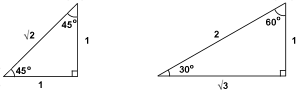
- Angle θ may be given in radians (R) where 1 revolution = 2πR = 360°
- Estimate square root 3 as 1.7 and root 2 as 1.4
- Cross-sectional area of a tube = area of a circle = πr2 where π can be estimated as 3.14 and r is the radius of the circle; circumference = 2πr
Practice sketching your vectors and triangles. Use our MCAT Erasable Noteboard and Marker to do a 'formula dump' during your tutorial, just like you will at the testing center.
MCAT Physics units to memorize
- Both work and energy are measured in joules where 1 joule (J) = 1 N × 1 m . {Imperial units: the foot-pound , CGS units: the dyne-centimeter or erg }
- The SI unit for power is the watt (W) which equals one joule per second (J/s) = volts × amperes.
- Current is measured in amperes = coulombs/sec. The units of resistance are ohms, symbolized by Ω (omega), where 1 ohm = 1 volt/ampere.
- The SI unit for pressure is the pascal (1 Pa = 1 N/m2 ). Other units are: 1.00 atm = 1.01 × 10⁵ Pa = 1.01 bar = 760 mmHg = 760 torr.
- The SI unit for the magnetic induction vector B is the tesla where 1 T = 1 N/(A)(m) = 104 gauss.
What to Focus On First
If you want to study this page efficiently, start with the equations that appear most often in basic mechanics, work and energy, fluids, circuits, waves, and optics. Once those feel familiar, move on to less common relationships and more conceptual formulas.
Students usually improve faster when they stop trying to memorize everything equally and instead focus on the formulas they are most likely to apply repeatedly.
Why Equation Pairs Matter
Many MCAT physics questions become easier when you recognize two related equations instead of treating them separately. Equation pairs help you move faster between concepts, manipulate variables more confidently, and check whether your setup makes sense.
This is especially useful when the exam wants reasoning, not just recall.
Practice Your Formula Dump
Practice sketching your vectors and triangles, and get comfortable writing out the formulas you want to recall quickly. Many students use the tutorial period before the exam to settle in and organize their thinking.
Use our MCAT Erasable Noteboard and Marker to practice doing a formula dump the way you might at the testing center.
What to Memorize vs. What to Understand
Not every physics formula should be studied the same way.
Memorize Cold
- core motion and force equations
- work, power, and energy equations
- momentum basics
- common fluid relationships
- circuit relationships
- common units and constants
Understand Deeply
- Bernoulli-related relationships
- Doppler effect
- magnetic force direction
- optics relationships
- conceptual wave behavior
Your goal is not to memorize blindly. Your goal is to know what the equation is telling you and when it is useful.
Reading formulas is helpful, but applying them is what builds real confidence. After reviewing this sheet, test yourself with realistic MCAT questions that require estimation, unit conversion, and equation selection under time pressure.
Frequently Asked Questions on MCAT Physics
How do you remember MCAT physics formulas?
The best way to remember MCAT physics formulas is to understand what each equation means, practice applying it in questions, and review the patterns that come up repeatedly. Students usually improve fastest when they combine formula review with timed practice questions and full-length exams. In a few cases, mnemonics can help, but understanding and application matter much more than memorization alone.
How hard is MCAT Physics?
MCAT physics can feel challenging because students must combine formulas, unit conversions, estimation, and mental math under time pressure. The content itself is based on common undergraduate physics topics, but what makes it difficult is using that knowledge quickly and accurately. With strong content review and consistent practice, it becomes much more manageable.
Is the MCAT Physics 1 or 2?
MCAT physics includes topics commonly taught across both introductory physics courses. Many questions are rooted in foundational Physics 1 concepts, but students are also expected to understand topics often associated with Physics 2, especially in electricity, waves, and optics. The best approach is to study based on the AAMC topic outline rather than course names alone.
Editorial Note: This content and the accompanying practice materials were developed and vetted by the Gold Standard MCAT Editorial Team. Our team—consisting of experienced medical educators, physicians, and subject matter specialists—is dedicated to providing the most accurate, representative prep materials and online courses for U.S. and Canadian premedical students.
Are equations provided on the MCAT?
Some information may appear in the context of a question, but you should expect to know the major physics formulas and relationships yourself. It is much safer to prepare as though you need to recall the most important equations without relying on the test to provide them.
Which physics equations matter most for the MCAT?
The most important equations are the ones tied to motion, force, work, energy, momentum, fluids, electricity, waves, optics, and common unit relationships. This page helps you identify the formulas and equation pairs that are most useful to review first.
Take the Next Step After Reviewing This Sheet
You do not need to stop at memorizing formulas. The next score gains usually come from practicing how to choose, combine, and apply them under realistic MCAT timing.