
MCAT Scores: High, Good and Average MCAT Scores for US and Canadian Medical Schools
Understand MCAT scores, Admissions Chances, and Medical School Competitiveness
MCAT Scoring and Medical School Admissions Guide
Your MCAT score is one of the most important academic factors in medical school admissions. Admissions committees use the MCAT to evaluate whether applicants are academically prepared for the rigor of medical school.
This guide explains how MCAT scores work, what counts as a competitive score, and how admissions committees evaluate MCAT performance alongside GPA and other components of the medical school application.
You will also find admissions data, MCAT percentile benchmarks, and a calculator that estimates your chances of admission to medical school in the United States and Canada.
Because every applicant’s situation is different, always review admissions information for the schools you plan to apply to and consult your pre-med advisor when possible.
MCAT Score Quick Answers
What is the MCAT score range?
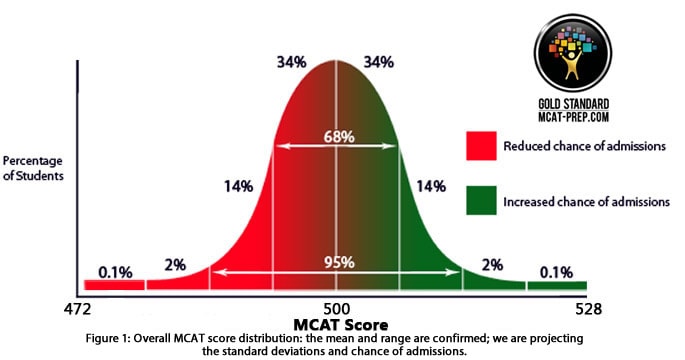
MCAT scores range from 472 to 528, with 500 representing the midpoint of the scoring scale.
What is a good MCAT score?
A good MCAT score is typically around 511 or higher (~80th percentile).
What MCAT score do most accepted students have?
Most accepted applicants score between 508 and 515.
What MCAT score is considered excellent?
Scores above 518 are generally considered excellent.
Can you get into medical school with a 500 MCAT score?
Yes. Some applicants with scores around 500 are admitted each year.
What is a Good MCAT Score?
A good MCAT score is typically considered to be 128 out of 132 in any one of the four sections, or a total of 511 out of 528 for all four sections combined. The latter represents the average score of students admitted to medical schools across the nation during the 2021 admissions cycle. However, it's important to understand that what constitutes an average, good, or high MCAT score can vary depending on perspective, the specific cohort of applicants, and the medical school to which you are applying. There is no definitive pass or fail score for the MCAT; rather, each medical school sets its own criteria for acceptable scores.
To determine the score needed for a particular medical school, it's best to consult the specific school's requirements or visit their website. Additionally, the Association of American Medical Colleges (AAMC) may provide useful information about past trends and average scores for medical school admissions. Keep in mind that achieving an acceptable MCAT score is just one aspect of a comprehensive medical school application, and other factors such as GPA, extracurricular activities, letters of recommendation, and personal statement are also crucial in the admissions process.
What score do you need for medical school? Here is a summary of the high, good and average MCAT scores acceptable to medical school.
Average MCAT score
50th percentile
Sectional score: 125
Combined score: 501
Good MCAT score
80th percentile
Sectional score: 128
Combined score: 511
High MCAT score
95th percentile
Sectional score: 130
Combined score: 518
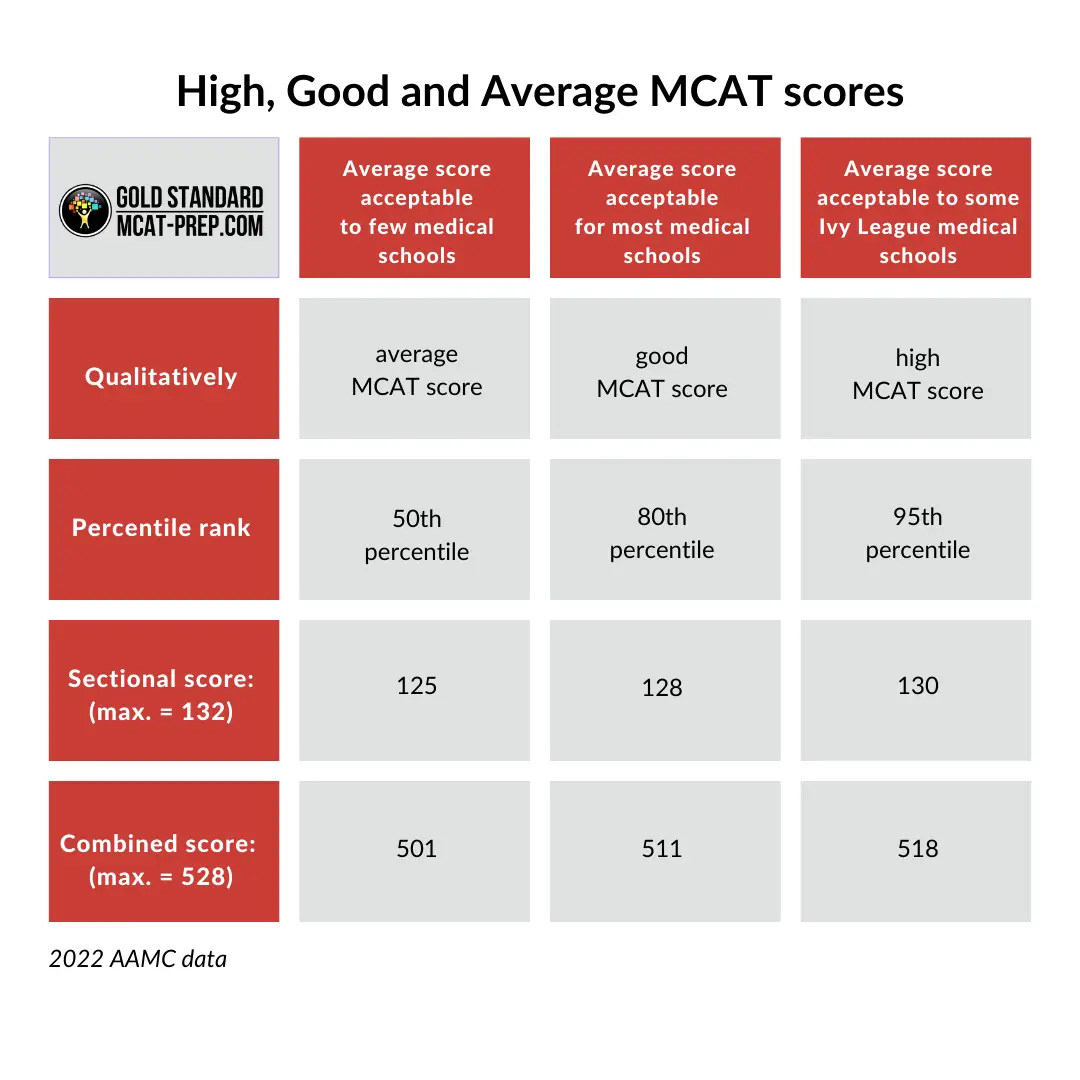
Note: the expression "average score" does not have the same meaning as cutoff or minimum score. Rather it refers to the simple average of students accepted to medical school (historic and predicted averages). Having an acceptable MCAT score in no way guarantees medical school admissions since acceptance is also contingent on GPA and non-academic factors (i.e. personal statement and/or autobiographical material, letters of reference, and the medical school interview)
MCAT Scores Range Explained
Each MCAT section is scored between 118 and 132, with 125 representing the midpoint.
The four MCAT sections are:
- Biological and Biochemical Foundations of Living Systems
- Chemical and Physical Foundations of Biological Systems
- Psychological, Social, and Biological Foundations of Behavior
- Critical Analysis and Reasoning Skills (CARS)
When the four section scores are combined, the total MCAT score ranges from 472 to 528, with 500 representing the midpoint of the scoring scale.
Admissions committees evaluate both total MCAT scores and individual section scores, particularly the CARS section, when assessing an applicant’s academic readiness for medical school.
MCAT Percentiles Explained
MCAT percentile rankings show how your score compares with other test-takers. Percentiles indicate the percentage of examinees who scored below a given score.
| MCAT Score | Percentile |
|---|---|
| 528 | 100th |
| 520 | 98th |
| 515 | 91st |
| 510 | 80th |
| 505 | 65th |
| 500 | 50th |
| 495 | 31st |
| 490 | 17th |
For example, a 510 MCAT score (80th percentile) means the student performed better than about 80 percent of examinees.
Many students use full-length MCAT practice tests to estimate their score range before taking the official exam.
Is a 510 MCAT Score Competitive?
Yes. A 510 MCAT score corresponds to roughly the 80th percentile, meaning the student scored higher than about 80 percent of examinees.
A 510 is considered competitive for many medical schools, particularly when combined with a strong GPA and meaningful clinical or research experiences.
How is the MCAT Scored?
Scores are based on correct answers only. There is no penalty for incorrect answers. Raw scores are converted to scaled scores to maintain fairness across test administrations.
Considering that each section of the exam has different sets of questions and level of difficulty, a student's performance on the MCAT is more likely to be accurately assessed by converting raw scores to scaled scores. The scaled score is reported on a 15-point scale.
There is no simplistic way to convert a percentage to a scaled score. It is a complex calculation that is dependent on the cohort and cannot be replicated with precision for any random practice exam. For example, a 50% raw score (i.e. the percent of correct answers) in a section does NOT represent 125 (a midpoint MCAT scaled score). Consider the table below.
Example of approximate percent correct MCAT score conversion for the Official AAMC MCAT Practice Exam (Scored) 1
| Exam Section | Percent Correct Raw Score (approx.) | MCAT Scaled Score with Range (/132) |
|---|---|---|
| 1. Chemical and Physical Foundations of Biological Systems | 50% | 123; 122-124 |
| 2. Critical Analysis and Reasoning Skills ('MCAT CARS') | 50% | 123; 122-124 |
| 3. Biological and Biochemical Foundations of Living Systems | 50% | 124; 123-125 |
| 4. Psychological, Social, and Biological Foundations of Behavior | 50% | 122; 121-123 |
Note: A score of 80% correct for each of the 4 exam subsections translates to an MCAT scaled score of 127, which further underlines the fact that the relationship between percent correct and scaled scores is not straightforward and the changes are not consistent across exam sections (there is a correlation, but they are not proportional). Again, the numbers above only apply to this one exam and cannot be blindly applied to other practice materials. As an example, Gold Standard practice exams required thousands of student submissions to develop an exam-specific scale score which continues to be adjusted as segments of the cohort's exam preparation improves over the years.
What Does the AAMC MCAT Score Report Show?
The AAMC's MCAT score report includes:
- Section scores
- Total score
- Percentile rankings
- Confidence bands
- Score profile
For example, a student will have a total MCAT score of 515 after scoring 131 on the Chemical and Physical Foundations of Biological Systems section; 127 on the Critical Analysis and Reasoning Skills section; 130 on the Biological and Biochemical Foundations of Living Systems section, and 127 on the Psychological, Social, and Biological Foundations of Behavior section. With a total score of 515, the student's percentile rank is 91%.
If you think that there is an error in your score, you may request the AAMC for a rescore.
| Section | Score | Confidence Band | Percentile Rank of Score | Score Profile |
|---|---|---|---|---|
| Chemical and Physical Foundations of Biological Systems | 131 | 130 🔶 132 | 99% |  |
| Critical Analysis and Reasoning Skills | 127 | 126 🔶 128 | 82% |  |
| Biological and Biochemical Foundations of Living Systems | 130 | 129 🔶 131 | 96% |  |
| Psychological, Social and Biological Foundations of Behavior | 127 | 126 🔶 128 | 68% |  |
| Total | 515 | 513 🔶 517 | 91% |
Is the Highest MCAT Score Possible?
Yes, achieving the highest possible scaled MCAT score (528) is possible. It’s rare but achievable.
MCAT Question Types and Section Breakdown
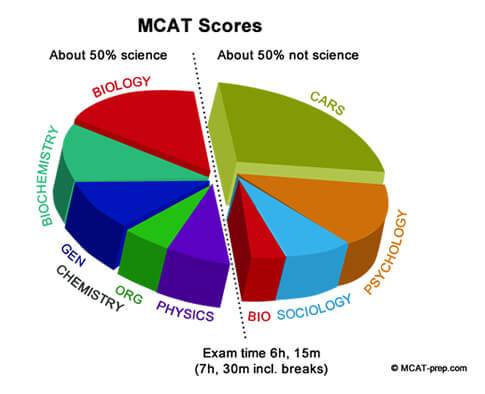
The four MCAT section scores reflect performance across a range of scientific disciplines and reasoning skills. The graphic below illustrates how the exam content is distributed across major subject areas.
Of special note:
- Biology and Biochemistry make up a substantial portion of the exam and appear across multiple sections.
- Psychology and Sociology test concepts related to behavior, social systems, and health outcomes.
- Critical Analysis and Reasoning Skills (CARS) evaluates reading comprehension and analytical reasoning using passages from the humanities and social sciences.
- The MCAT is not divided strictly into “science” and “non-science” content. Some sections integrate concepts from multiple disciplines to reflect the interdisciplinary nature of modern medicine.
When Are MCAT Scores Released?
MCAT scores are released 30-35 days after the exam date and at 5 pm of the release date.
How Do Medical Schools Handle Multiple MCAT Scores?
How do medical schools handle your multiple MCAT scores if you have taken the exam more than once? They may do any of the following:
- Evaluate the most recent score
- Evaluate only the highest individual and/or set of scores
- Evaluate an average of the sets of scores
- Consider all scores equally and note the improvements
Contact the medical schools you intend to apply to determine how they would handle your multiple scores. Also, please note that many medical schools do not accept scores that are more than three years old.
In addition to your MCAT score, admissions committees consider other factors in your medical school application including your GPA, personal and academic experiences, demographics, medical school interview, letters of evaluation or recommendation, and personal statement.
Should You Retake the MCAT?
Students often wonder whether retaking the MCAT will significantly improve their score.
According to data from the Association of American Medical Colleges (AAMC):
- Most students who retake the MCAT improve their score
- The median improvement is typically between 1 and 3 points, depending on the initial score
- Score changes vary, and some students may see little improvement or even a decrease
While larger increases are possible, they are less common and often require meaningful changes in preparation.
Retaking the MCAT can be beneficial in some situations, but it should be approached strategically.
An early lower score does not automatically disqualify an applicant. Admissions committees evaluate the entire academic record, experiences, and personal growth when reviewing applications. Some medical schools focus on your most recent MCAT scores, others look for trends among your scores (e.g., improvement over time), while very few medical schools will average scores (the latter is not standard).
MCAT Retake Decision Guide
Consider retaking if:
- Your score is below target school averages
- External factors affected your exam
- You significantly changed your study strategy
Preparing for a retake often involves reviewing mistakes and completing additional realistic MCAT practice tests under timed conditions. Avoid retaking MCAT mock exams because that would not be a strong indicator of future success since you will recognize many questions, to one degree or another. Of course, you should study your notes from what you may have learned from past practice tests, but ideally, you would try other mock exams so that you are exposed to new material, which is more likely to simulate the feeling or retaking the real MCAT.
MCAT Scores and Medical School Acceptance Rates
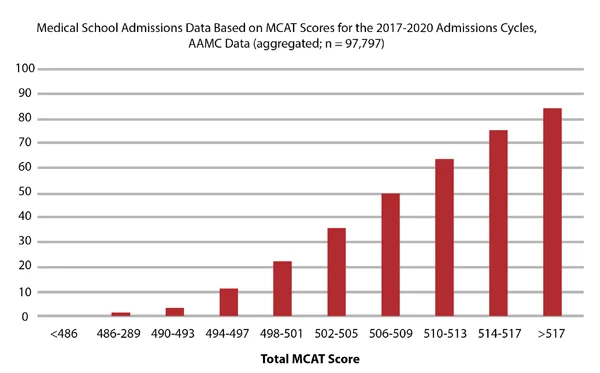
The higher rates of admissions with higher MCAT scores are nothing new. However, it is of value to note that a score of 500 has a rate of admissions just over 20% and lesser scores may still result in admissions. Conversely, an exceptional score (above 517) does not guarantee medical school admissions.
Preparing for a Competitive MCAT Score
Strong MCAT preparation typically includes:
- structured content review
- passage‑based practice
- full‑length exams
- analysis of mistakes
For more than 30 years, Gold Standard has helped students prepare using realisticfull-length MCAT practice exams designed to mirror the real exam experience.
Average MCAT and GPA Requirements for Medical Schools
Below, you will find the average MCAT score and GPA requirements for medical schools in both the United States and Canada.
| Medical Schools in Alabama | Median GPA | Median MCAT Score |
|---|---|---|
| Alabama College of Osteopathic Medicine | 3.45 | 504 |
| Edward Via College of Osteopathic Medicine | 3.62 | 496 |
| University of Alabama School of Medicine | 3.86 | 510 |
| University of South Alabama College of Medicine | 3.91 | 511 |
| Medical Schools in Arizona | Median GPA | Median MCAT Score |
|---|---|---|
| A.T. Still University School of Osteopathic Medicine | 3.61 | 504 |
| Midwestern University Arizona College of Osteopathic Medicine | 3.5 | 505 |
| University of Arizona College of Medicine-Tucson | 3.79 | 510 |
| University of Arizona College of Medicine-Phoenix | 3.84 | 515 |
| Medical Schools in Arkansas | Median GPA | Median MCAT Score |
|---|---|---|
| Arkansas College of Osteopathic Medicine | 3.5 | 500 |
| University of Arkansas for Medical Sciences College of Medicine | 3.86 | 510 |
| Medical Schools in Colorado | Median GPA | Median MCAT Score |
|---|---|---|
| Rocky Vista University College of Osteopathic Medicine | 3.66 | 504 |
| University of Colorado School of Medicine | 3.86 | 514 |
| Medical Schools in Connecticut | Median GPA | Median MCAT Score |
|---|---|---|
| Quinnipiac University Frank H. Netter MD School of Medicine | 3.71 | 514 |
| University of Connecticut School of Medicine | 3.78 | 513 |
| Yale School of Medicine | 3.93 | 521 |
| Medical Schools in District of Columbia | Median GPA | Median MCAT Score |
|---|---|---|
| George Washington University School of Medicine and Health Sciences | 3.78 | 513 |
| Georgetown University School of Medicine | 3.79 | 513 |
| Howard University College of Medicine | 3.53 | 505 |
| Medical Schools in Florida | Median GPA | Median MCAT Score |
|---|---|---|
| Florida Atlantic University Charles E Schmidt College of Medicine | 3.8 | 513 |
| Florida International University Herbert Wertheim College of Medicine | 3.71 | 511 |
| Florida State University College of Medicine | 3.76 | 505 |
| Lake Erie College of Osteopathic Medicine | 3.5 | 50th percentile |
| Nova Southeastern University Dr. Kiran C. Patel College of Allopathic Medicine | 3.72 | 512 |
| Nova Southeastern University Dr. Kiran C. Patel College of Osteopathic Medicine | 3.5 | 506 |
| University of Central Florida College of Medicine | 3.88 | 514 |
| University of Florida College of Medicine | 3.9 | 515 |
| University of Miami Leonard M. Miller School of Medicine | 3.78 | 513 |
| University of South Florida Health Morsani College of Medicine | 3.83 | 517 |
| Medical Schools in Georgia | Median GPA | Median MCAT Score |
|---|---|---|
| Emory University School of Medicine | 3.7 | 514 |
| Medical College of Georgia at Augusta University | 3.82 | 513 |
| Mercer University School of Medicine | 3.73 | 504 |
| Morehouse School of Medicine | 3.63 | 504 |
| Philadelphia College of Osteopathic Medicine | 3.5 | 500 |
| Medical Schools in Hawaii | Median GPA | Median MCAT Score |
|---|---|---|
| University of Hawaii John A. Burns School of Medicine | 3.74 | 511 |
| Medical Schools in Idaho | Median GPA | Median MCAT Score |
|---|---|---|
| Idaho College of Osteopathic Medicine | 3.2 | 50th percentile |
| Medical Schools in Illinois | Median GPA | Median MCAT Score |
|---|---|---|
| Carle Illinois College of Medicine | 3.71 | 513 |
| Chicago Medical School at Rosalind Franklin University of Medicine & Science | 3.74 | 513 |
| Loyola University Chicago Stritch School of Medicine | 3.76 | 512 |
| Midwestern University Chicago College of Osteopathic Medicine | 3.61 | 506 |
| Northwestern University The Feinberg School of Medicine | 3.91 | 520 |
| Rush Medical College of Rush University | 3.67 | 511 |
| Southern Illinois University School of Medicine | 3.81 | 506 |
| University of Chicago Pritzker School of Medicine | 3.93 | 521 |
| University of Illinois College of Medicine | 3.76 | 513 |
| Medical Schools in Indiana | Median GPA | Median MCAT Score |
|---|---|---|
| Indiana University School of Medicine | 3.84 | 512 |
| Marian University College of Osteopathic Medicine | 3.6 | 503 |
| Medical Schools in lowa | Median GPA | Median MCAT Score |
|---|---|---|
| Des Moines University College of Osteopathic Medicine | 3.63 | 506 |
| University of lowa Carver College of Medicine | 3.86 | 515 |
| Medical Schools in Kansas | Median GPA | Median MCAT Score |
|---|---|---|
| University of Kansas School of Medicine | 3.88 | 512 |
| Medical Schools in Kentucky | Median GPA | Median MCAT Score |
|---|---|---|
| University of Kentucky College of Medicine | 3.81 | 508 |
| University of Louisville School of Medicine | 3.77 | 509 |
| University of Pikeville Kentucky College of Osteopathic Medicine | 3.5 | 500 |
| Medical Schools in Louisiana | Median GPA | Median MCAT Score |
|---|---|---|
| Louisiana State University School of Medicine - New Orleans | 3.82 | 509 |
| Louisiana State University School of Medicine - Shreveport | 3.77 | 506 |
| Tulane University School of Medicine | 3.63 | 511 |
| Medical Schools in Maine | Median GPA | Median MCAT Score |
|---|---|---|
| University of New England College of Osteopathic Medicine | 3.6 | Minimum 490 |
| Medical Schools in Maryland | Median GPA | Median MCAT Score |
|---|---|---|
| Johns Hopkins University School of Medicine | 3.9 | 521 |
| Uniformed Services University of the Health Sciences F. Edward Hebert School of Medicine | 3.7 | 510 |
| University of Maryland School of Medicine | 3.8 | 514 |
| Medical Schools in Massachusetts | Median GPA | Median MCAT Score |
|---|---|---|
| Boston University School of Medicine | 3.8 | 518 |
| Harvard Medical School | 3.9 | 520 |
| Tufts University School of Medicine | 3.7 | 513 |
| University of Massachusetts Medical School | 3.8 | 516 |
| Medical Schools in Michigan | Median GPA | Median MCAT Score |
|---|---|---|
| Central Michigan University College of Medicine | 3.7 | 508 |
| Michigan State University College of Human Medicine | 3.7 | 509 |
| Michigan State University College of Osteopathic Medicine | 3.5 | 505 |
| Oakland University William Beaumont School of Medicine | 3.8 | 510 |
| University of Michigan Medical School | 3.8 | 518 |
| Wayne State University School of Medicine | 3.8 | 513 |
| Western Michigan University Homer Stryker M.D. School of Medicine | 3.7 | 516 |
| Medical Schools in Minnesota | Median GPA | Median MCAT Score |
|---|---|---|
| Mayo Medical School | 3.9 | 520 |
| University of Minnesota Medical School - Twin Cities | 3.8 | 513 |
| University of Minnesota Medical School - Duluth | 3.7 | 504 |
| Medical Schools in Mississippi | Median GPA | Median MCAT Score |
|---|---|---|
| William Carey University College of Osteopathic Medicine | 3.4 | 501 |
| University of Mississippi School of Medicine | 3.8 | 505 |
| Medical Schools in Missouri | Median GPA | Median MCAT Score |
|---|---|---|
| A.T. Still University Kirksville College of Osteopathic Medicine | 2.8 | 504 |
| Kansas City University of Medicine and Biosciences College of Osteopathic Medicine | 3.56 | 505 |
| Saint Louis University School of Medicine | 3.91 | 514 |
| University of Missouri School of Medicine - Columbia | 3.86 | 509 |
| University of Missouri School of Medicine - Kansas City | 3.89 | 509 |
| Washington University School of Medicine | 3.94 | 521 |
| Medical Schools in Nebraska | Median GPA | Median MCAT Score |
|---|---|---|
| Creighton University School of Medicine | 3.84 | 513 |
| University of Nebraska College of Medicine | 3.9 | 513 |
| Medical Schools in Nevada | Median GPA | Median MCAT Score |
|---|---|---|
| Touro University Nevada College of Osteopathic Medicine | 3 | 500 |
| University of Nevada School of Medicine - Las Vegas | 3.76 | 512 |
| University of Nevada School of Medicine - Reno | 3.82 | 509 |
| Medical Schools in New Hampshire | Median GPA | Median MCAT Score |
|---|---|---|
| Geisel School of Medicine at Dartmouth | 3.77 | 516 |
| Medical Schools in New Jersey | Median GPA | Median MCAT Score |
|---|---|---|
| Cooper Medical School of Rowan University | 3.79 | 512 |
| Rowan University School of Osteopathic Medicine | 3.59 | 505 |
| Rutgers New Jersey Medical School | 3.82 | 515 |
| Rutgers Robert Wood Johnson Medical School | 3.75 | 514 |
| Medical Schools in New Mexico | Median GPA | Median MCAT Score |
|---|---|---|
| Burrell COM at New Mexico State University | Science - 3 | 493 |
| University of New Mexico School of Medicine | 3.8 | 505 |
| Medical Schools in New York | Median GPA | Median MCAT Score |
|---|---|---|
| Albany Medical College | 3.74 | 511 |
| Albert Einstein College of Medicine | 3.81 | 515 |
| Columbia University College of Physicians and Surgeons | 3.92 | 522 |
| Hofstra Northwell School of Medicine | 3.73 | 515 |
| Icahn School of Medicine at Mount Sinai | 3.87 | 519 |
| New York Institute of Technology College of Osteopathic Medicine | 3.6 | 504 |
| New York Medical College | 3.72 | 513 |
| New York University School of Medicine | 3.95 | 522 |
| SUNY - Downstate Medical Center College of Medicine | 3.74 | 514 |
| SUNY - Buffalo Jacobs School of Medicine and Biomedical Sciences | 3.75 | 512 |
| SUNY - Upstate Medical University | 3.77 | 513 |
| Stony Brook University Renaissance School of Medicine | 3.86 | 516 |
| Touro College of Osteopathic Medicine | 3.5 | 504 |
| University of Rochester School of Medicine and Dentistry | 3.84 | 518 |
| Weill Cornell Medical College | 3.91 | 519 |
| Medical Schools in North Carolina | Median GPA | Median MCAT Score |
|---|---|---|
| Campbell University School of Osteopathic Medicine | 3.5 | 503 |
| Duke University School of Medicine | 3.89 | 519 |
| East Carolina University Brody School of Medicine | 3.71 | 509 |
| University of North Carolina at Chapel Hill School of Medicine | 3.78 | 515 |
| Wake Forest School of Medicine | 3.76 | 513 |
| Medical Schools in North Dakota | Median GPA | Median MCAT Score |
|---|---|---|
| University of North Dakota School of Medicine and Health Sciences | 3.8 | 507 |
| Medical Schools in Ohio | Median GPA | Median MCAT Score |
|---|---|---|
| Case Western Reserve University School of Medicine | 3.86 | 519 |
| Northeast Ohio Medical University | 3.76 | 507 |
| Ohio University Heritage College of Osteopathic Medicine | 3.92 | 517 |
| The Ohio State University College of Medicine | 3.92 | 517 |
| The University of Toledo College of Medicine and Life Sciences | 3.76 | 510 |
| University of Cincinnati College of Medicine | 3.84 | 517 |
| Wright State University Boonshoft School of Medicine | 3.73 | 508 |
| Medical Schools in Oklahoma | Median GPA | Median MCAT Score |
|---|---|---|
| Oklahoma State University College of Osteopathic Medicine | 3.6 | 500 |
| University of Oklahoma College of Medicine | 3.85 | 511 |
| Medical Schools in Oregon | Median GPA | Median MCAT Score |
|---|---|---|
| Oregon Health & Science University School of Medicine | 3.77 | 512 |
| Medical Schools in Pennsylvania | Median GPA | Median MCAT Score |
|---|---|---|
| Drexel University College of Medicine | 3.75 | 512 |
| Geisinger Commonwealth School of Medicine | 3.76 | 512 |
| Lake Erie College of Osteopathic Medicine | 3.5 | 50th percentile |
| Pennsylvania State University College of Medicine | 3.81 | 512 |
| Perelman School of Medicine University of Pennsylvania | 3.94 | 522 |
| Philadelphia College of Osteopathic Medicine | 3.5 | 500 |
| Sidney Kimmel Medical College at Thomas Jefferson University | 3.8 | 514 |
| Temple University Lewis Katz School of Medicine | 3.7 | 513 |
| University of Pittsburgh School of Medicine | 3.86 | 518 |
| Medical Schools in Puerto Rico | Median GPA | Median MCAT Score |
|---|---|---|
| Ponce School of Medicine and Health Sciences | 3.64 | 499 |
| San Juan Bautista School of Medicine | 3.71 | 498 |
| Universidad Central Del Caribe School of Medicine | 3.73 | 499 |
| University of Puerto Rico School of Medicine | 3.82 | 505 |
| Medical School in Rhode Island | Median GPA | Median MCAT Score |
|---|---|---|
| Brown University The Warren Alpert Medical School | 3.83 | 517 |
| Medical Schools in South Carolina | Median GPA | Median MCAT Score |
|---|---|---|
| Edward Via College of Osteopathic Medicine - Carolinas Campus | 3.6 | 513 |
| Medical University of South Carolina College of Medicine | 3.83 | 510 |
| University of South Carolina School of Medicine - Columbia | 3.79 | 508 |
| University of South Carolina School of Medicine - Greenville | 3.81 | 509 |
| Medical School in South Dakota | Median GPA | Median MCAT Score |
|---|---|---|
| University of South Dakota Sanford School of Medicine | 3.87 | 508 |
| Medical Schools in Tennessee | Median GPA | Median MCAT Score |
|---|---|---|
| East Tennessee State University Quillen College of Medicine | 3.81 | 508 |
| Lincoln Memorial University DeBusk College of Osteopathic Medicine | 3.58 | 502 |
| Meharry Medical College School of Medicine | 3.52 | 503 |
| University of Tennessee Health Science Center College of Medicine | 3.82 | 513 |
| Vanderbilt University School of Medicine | 3.94 | 521 |
| Medical Schools in Texas | Median GPA | Median MCAT Score |
|---|---|---|
| Baylor College of Medicine | 3.93 | 518 |
| Texas A&M Health Science Center College of Medicine | 3.84 | 513 |
| Texas Tech University Health Sciences Center Paul L. Foster School of Medicine | 3.89 | 512 |
| Texas Tech University Health Sciences Center School of Medicine - Lubbock | 3.87 | 510 |
| University of the Incarnate Word School of Osteopathic Medicine | 3.48 | 501 |
| University of North Texas Health Science Center-Texas College of Osteopathic Medicine | 3.71 | 510 |
| University of Texas at Austin Dell Medical School | 3.92 | 515 |
| University of Texas Medical Branch School of Medicine | 3.88 | 511 |
| University of Texas McGovern Medical School at Houston | 3.88 | 513 |
| University of Texas Rio Grande Valley School of Medicine | 3.72 | 510 |
| University of Texas School of Medicine at San Antonio | 3.88 | 517 |
| University of Texas Southwestern Medical School | 3.9 | 518 |
| Medical School in Utah | Median GPA | Median MCAT Score |
|---|---|---|
| University of Utah School of Medicine | 3.82 | 513 |
| Medical School in Vermont | Median GPA | Median MCAT Score |
|---|---|---|
| University of Vermont Larner College of Medicine | 3.73 | 512 |
| Medical Schools in Virginia | Median GPA | Median MCAT Score |
|---|---|---|
| Eastern Virginia Medical School | 3.71 | 513 |
| Edward Via College of Osteopathic Medicine | 3.56 | 500 |
| Liberty University College of Osteopathic Medicine | 3.4 | 500 |
| University of Virginia School of Medicine | 3.93 | 520 |
| Virginia Commonwealth University School of Medicine | 3.82 | 513 | <
| Virginia Tech Carilion School of Medicine and Research Institute | 3.57 | 512 |
| Medical Schools in Washington | Median GPA | Median MCAT Score |
|---|---|---|
| George Washington University School of Medicine and Health Sciences | 3.7 | 510 |
| Georgetown University School of Medicine | 3.74 | 512 |
| Pacific Northwest University of Health Sciences College of Osteopathic Medicine | 3.46 | 502 |
| University of Washington School of Medicine | 3.74 | 512 |
| Washington State University Elson S. Floyd College of Medicine | 3.67 | 510 |
| Medical Schools in West Virginia | Median GPA | Median MCAT Score |
|---|---|---|
| Marshall University Joan C. Edwards School of Medicine | 3.7 | 502 |
| West Virginia School of Osteopathic Medicine | 3.4 | 500 |
| West Virginia University School of Medicine | 3.88 | 509 |
| Medical Schools in Wisconsin | Median GPA | Median MCAT Score |
|---|---|---|
| Medical College of Wisconsin | 3.73 | 511 |
| University of Wisconsin School of Medicine and Public Health | 3.8 | 513 |
Medical School Admissions Calculator
| Calculate your chances of getting into medical school |
|---|
Note: Individual circumstances may vary. Past patterns do not guarantee future admissions patterns. This webpage does not collect nor try to collect any personally identifiable data.
* To properly interpret the results of the medical school admissions calculator, keep in mind the following: (1) these are average statistics based on US rates of medical school admissions in the last 5 years as published online by the AAMC; (2) the above does not reveal the variations between specific universities or colleges: keep in mind that individual medical schools may be significantly more or less competitive than others; (3) The overall statistical chance of admissions to medical school, though correlates best with numerical achievement in recent history, also varies based on personal experience. Such experience is transmitted through various tools of the admissions process. This non-academic part of medical school admissions can be revealed through your Personal Statement, letters of reference and the medical school interview. Consult your premed advisor and the admissions information for the specific medical schools which interest you to determine the weight given to the different aspects of the admissions process, as well as the cutoff and/or average GPA/MCAT scores for each medical school to which you intend to apply.