
What Is the MCAT?
MCAT Sections, Length, Eligibility, Timing, and Prep
The MCAT, or Medical College Admission Test, is a standardized multiple-choice exam administered by the Association of American Medical Colleges (AAMC). It is required for admission to nearly all medical schools in the United States and Canada, and each year more than 80,000 applicants submit MCAT scores as part of the medical school admissions process.
Since its 2015 update, the MCAT has focused heavily on reasoning skills, while still requiring a broad foundation in the natural, behavioral, and social sciences. The exam tests not only content knowledge, but also problem-solving, data interpretation, and critical thinking skills that are essential for success in medical school.
On this page, you can learn about MCAT difficulty, sections, subjects, timing, eligibility, when to take the exam, retake limits, and the prep materials you may need. Use the intrapage links below to jump directly to the section you want.
How Hard Is the MCAT? | Do You Need the MCAT? | MCAT Sections | MCAT Subjects |
Exam Length | Who Can Take It?
When to Take It | How Many Times? |
Prep Materials
Is the MCAT very hard?
Yes, the MCAT is hard. Its purpose is to ensure that the students who get accepted to medical school not only have a good foundation of scientific facts and relevant formulae, but also the mental agility to look holistically at the sciences (take in the big picture), and yet be comfortable at critically analyzing scientific data with the depth of perception (focus on the necessary details). Not only that, but the test also seeks to probe what you know about your thoughts, feelings, and functioning impact your actions and behavior may have on patients (psychology and social sciences section).
Do all medical schools require the MCAT?
No, not all, but the majority of medical schools in the United States and Canada require the MCAT for admission. Whether you intend to apply solely to medical school or submit your application to graduate school and medical school, your exam score should be included with your application. Most graduate and professional schools require a standardized test to be completed prior to matriculation and the exam is often accepted to meet that requirement.
What are the 4 MCAT Sections?
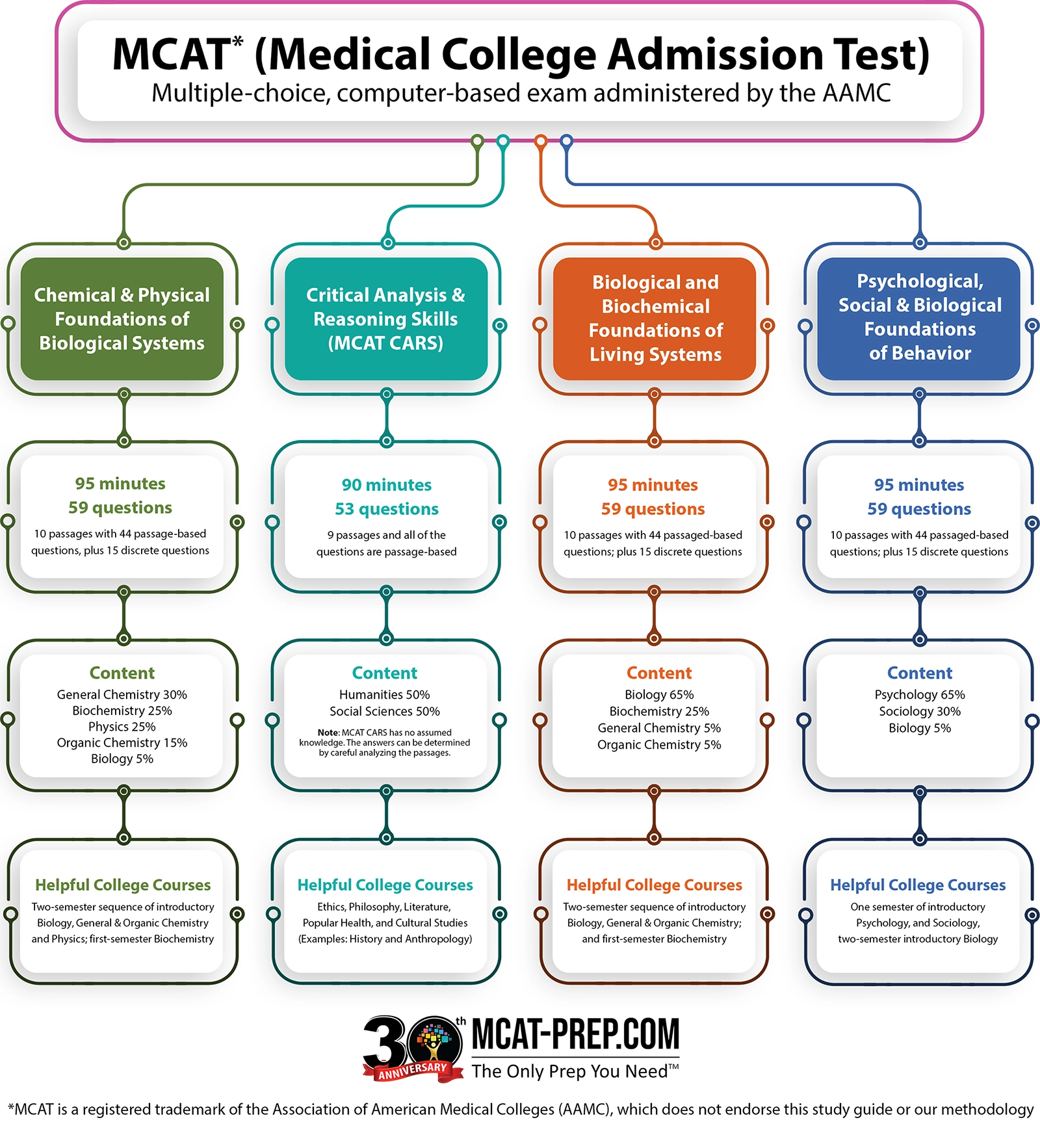
The MCAT exam has four sections, namely: (1) Chemical and Physical Foundations of Biological Systems; (2) Critical Analysis and Reasoning Skills (MCAT CARS); (3) Biological and Biochemical Foundations of Living Systems; and (4) Psychological, Social and Biological Foundations of Behavior.
How many questions are in the MCAT exam?
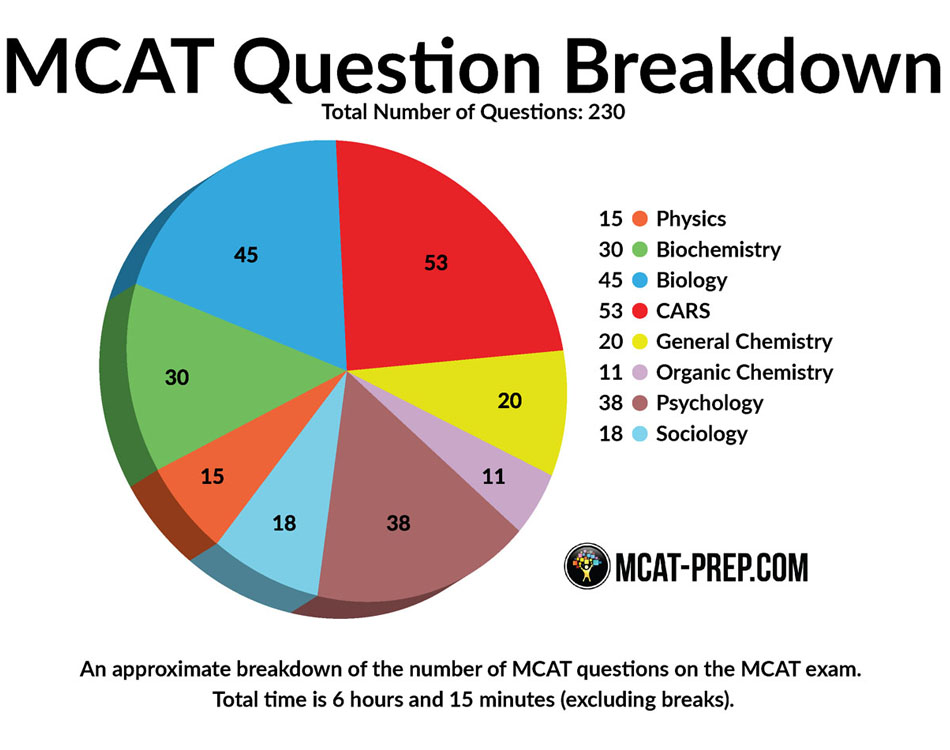
The MCAT exam has 230 questions including passage-based questions and discrete questions.
What subjects are tested on the MCAT?
- Organic and inorganic chemistry
- Physics
- Biology
- Biochemistry
- Basis research methods and statistics
- Psychology
- Sociology
- Ethics, philosophy, cultural studies as well as population health, social sciences and humanities
The table below shows the subjects tested in every MCAT section including the number of questions as well as percentage of the subjects.
For a detailed list of topics for each of the 4 MCAT sections, check out this helpful MCAT Topics List.
How long is the MCAT?
The MCAT is 7 hours and 30 minutes long, including breaks. The image below shows the detailed breakdown of the four MCAT sections, the subjects included, the time allocated to each section, as well as the breaks.
Before the exam: sign in, present a valid ID, have your palms digitally scanned, and have your test day photo taken.

MCAT Test Day Schedule
The exam is offered several times a year from January to September in the United States, Canada and international locations.
| MCAT Exam Section | Questions | Duration | Notes |
|---|---|---|---|
Test day certification |
- |
4 minutes |
A reminder of your obligation as MCAT examinee |
Tutorial (optional) |
- |
10 minutes |
Login to the AAMC MCAT hub, go to the free resources section and access the "Practice with MCAT Exam Features" tutorial |
Chemical and Physical Foundations of Biological Systems (AKA: Chem/Phys) [Note: many students are surprised to see that about 1/3 of this section is BCM + BIO] BCM 25% • BIO 5% • CHM 30% • ORG 15% • PHY 25% |
59 questions: 10 passages with 44 passage-based questions, plus 15 discrete questions |
95 minutes |
These questions are focused on mechanisms operating in the human body as well as basic chemical and physical principles which are the foundations of mechanisms operating in the human body. Includes basic research methods and statistics. |
Break (optional)* |
- |
10 minutes |
You can't leave the testing center. You will have access to only food, water, and medicine(s). You can't access electronic devices and study materials. Plan your break wisely. Also, track your break time with the watch at the testing center's waiting area. |
Critical Analysis and Reasoning Skills (AKA:CARS) |
53 questions: 9 passages and all of the questions are |
90 minutes |
These questions cover principles in the humanities and social sciences as well as focus on critically evaluating information given in a passage. There is no specific assumed knowledge. |
Mid-Exam Break (optional)* |
- |
30 minutes |
You can't leave the testing center. You will have access to only food, water, and medicines. You can't access electronic devices and study materials. Plan and spend your break wisely. Also, track your break time with the watch at the testing center's waiting area. |
Biological and Biochemical Foundations of Living Systems (AKA:Bio/Bcm) [Some heavy research BCM/BIO passages mixed with 'old school' BIO passages] BCM 25% • BIO 65% • CHM 5% • ORG 5% |
59 questions: 10 passages with 44 passage-based questions, plus 15 discrete questions |
95 minutes |
These questions are focused on how cells and organs in living organisms act independently and interdependently, as well as processes at different levels of biological organization within a living system. Includes basic research and statistics skills. |
Break (optional)* |
- |
10 minutes |
You can't leave the testing center. You will have access to only food, water, and medicines. You can't access electronic devices and study materials. Plan and spend your break wisely. Also, track your break time with the watch at the testing center's waiting area. |
Psychological, Social, and Biological Foundations of Behavior (AKA:Psych/Soc) [These MCQs are often knowledge-based and so do not tend to use the same advanced reasoning skills as avg MCQs from the other 3 sections.] PSY 65% • SOC 30% • BIO 5% |
59 questions: 10 passages with 44 passage-based questions, plus 15 discrete questions |
95 minutes |
These questions are focused on how people think and feel about themselves and others, how socio-cultural differences influence well-being as well as relationships between social stratification, access to resources, and well-being. Includes basic research methods and statistics. |
Void Question |
- |
3 minutes |
After you finish the exam, you will see a screen wherein you will choose between submitting or voiding your MCAT score. |
Satisfaction Survey (optional) |
12 |
5 minutes |
The survey helps AAMC to better understand the students' experiences and career plans. |
Total Content Time |
- |
6 hours, 15 minutes |
- |
Total "Seated" Time* |
- |
Approx. 7 hours, 33 minutes |
- |
Who can take the MCAT?
Individuals seeking admission to certain programs are eligible to take the MCAT. These programs include schools issuing a Doctor of Medicine (MD) degree, Doctor of Osteopathy (DO) degree, Doctor of Podiatric Medicine (DPM) degree, Doctor of Veterinary Medicine (DVM) degree, or any other health profession program that accepts MCAT scores to meet an admission requirement. Anyone who does not meet these criteria may request special permission from the AAMC to take the exam.
During registration, you will be asked to verify your intention to apply to medical school or to a health profession's school. There are no academic prerequisites to take the exam. Students with science and non-science backgrounds can take the exam and have the same opportunity to enter medical school. There is no age limit as well.
When should you take the MCAT?
Prospective students usually arrange to take the MCAT a year before their intended matriculation into medical school. For example, if you are eyeing medical school in 2026, then you can take the MCAT in 2025 or before.
Since there are no academic prerequisites for the MCAT, you can take the MCAT as early as your freshman, sophomore or junior year of undergraduate studies as long as you feel that you are ready. You may consult with your pre-health advisor. (Read: How to determine when to take the MCAT)
One important consideration is whether or not you will re-take the MCAT. Should you feel that you might take the MCAT more than once, it's ideal to take the MCAT early in the testing year. This will give you time to receive your scores and make a decision.
Another consideration is readiness. Have you thoroughly prepared for the content and skills that are required for the MCAT? Ideally, you should start your MCAT prep at least six months prior to your test date. (MCAT Test Dates)
The pie chart below shows that 2/3rds took the exam in August and September. This suggests that having most or all of the summer available for MCAT preparation may be one factor in gaining a high MCAT score.

How many times can you take the MCAT?
You can take the MCAT up to three times in a single testing year, up to four times in a two consecutive-year period, and up to seven times in a lifetime. Obviously, you want to minimize the number of times you need to take such a rigorous exam, and that is clearly the value of good preparation. Furthermore, medical schools will not review your application until they receive all your scores from the AAMC.
| Period | Number of Times Permitted to Take the MCAT |
|---|---|
| Single testing year | Up to 3 times |
| Two consecutive-year period | Up to 4 times |
| Lifetime | Up to 7 times |
Note: A voided exam and a 'no show' are counted as attempts in taking the exam. There is no required waiting period before you can retake the MCAT. But you may be able to register for a new MCAT date 48 hours after your exam day.
To determine if you should retake the MCAT, know the average MCAT score required by the medical school of your choice as well as their acceptance rates. If your score is competitive, the focus might not be on the need to retake the exam. You may need to evaluate your medical school interview, or autobiographical materials, or possibly your GPA. If your GPA is low, you may benefit from additional undergraduate or graduate studies (consult your premed advisor for additional insight), or you may benefit from a higher score.
If you feel that retaking the exam is the way to go, we have assembled MCAT prep courses and MCAT practice tests that would help you prepare better. Consider reading Finding the Courage to Retake the MCAT.
How are the multiple scores evaluated?
Some schools consider only your most recent score, whereas others will accept your highest score for each section. In other cases, medical schools may rely solely on percentile rank when comparing your multiple scores. Just keep in mind that medical schools will see all your exam attempts during their review of your application. For guidance on how the MCAT is scored and to calculate your chances of getting accepted to medical school, click here: MCAT Scores.
What MCAT prep materials do you need?
To help you prepare for the MCAT exam, the Gold Standard offers 8 full-length MCAT practice tests that are scored. To access the complete exam experience, including up to 12 MCAT practice tests, sign up now:
- Free MCAT Practice Test - 230 practice problems, helpful explanations, scored
- MCAT Practice Tests - Online mock exams following the real exam’s format, many science problems also include background information in video format
- Book - 7 Full-length MCAT Practice Tests: 5 full-length exams in the book, and 2 online in the current AAMC format
- Online and home study courses
Gold Standard also recommends official sample questions from the AAMC:
- MCAT Sample Question Guide
- AAMC Full-length MCAT Practice Exams
Don't miss this opportunity to enhance your preparation and maximize your potential for achieving your dream score.
Free Resources
- MCAT Topics List - all topics per AAMC guidelines
- MCAT Preparation Guide - what you need to get a high score
- MCAT Test Dates - when to sit the exam and when the scores are released
- MCAT Scores - How is the exam score calculated and what score is needed to get admitted to medical school
- Practice Test Advice - There actually is a right and a wrong way of taking practice tests!
- Free MCAT Sample Questions - Test your MCAT level!